Why Didn't Jesus Correct Satan?
In the wilderness, Satan offered Jesus the kingdoms of the world. Jesus didn't argue. He simply quoted Scripture. Why?
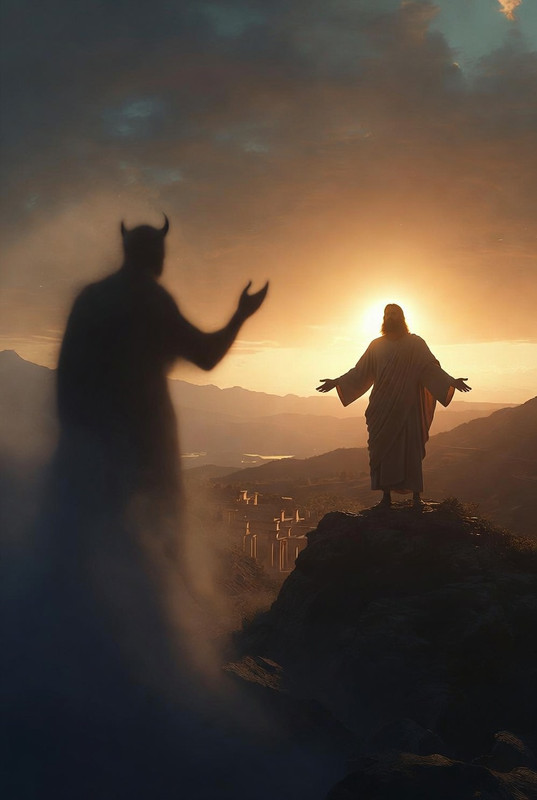
The Striking Silence in the Wilderness
In Luke 4, during the temptation of Jesus in the wilderness, Satan makes a stunning offer. He shows Jesus all the kingdoms of the world in an instant and says:
“To you I will give all this authority and their glory, for it has been delivered to me, and I give it to whomever I want. If you, then, will worship me, it will all be yours.” — Luke 4:6-7 (ESV)
What’s striking is what Jesus doesn’t do. He doesn’t push back with, “No, Satan, you’re wrong—these kingdoms belong to me!” He doesn’t correct the claim that dominion over the world’s kingdoms had been “delivered” to Satan.
Instead, Jesus simply rejects the temptation by quoting Scripture: “You shall worship the Lord your God, and him only shall you serve” (Luke 4:8). He refuses to worship anyone but God.
This raises a profound question for anyone diving deep into Scripture: If Jesus is the King of kings and Lord of lords, why does He seem to acknowledge Satan’s temporary claim to worldly authority?
The answer lies in a beautiful thread that runs from Genesis through Jeremiah, the Gospels, and all the way to Revelation — a picture of dominion, loss, redemption, and ultimate restoration.
The Original Dominion: God’s Gift to Humanity
It starts in Genesis. God creates the earth and everything in it, so ultimate ownership belongs to Him. But He delegates authority — dominion — over creation to Adam and Eve:
“Be fruitful and multiply and fill the earth and subdue it, and have dominion over the fish of the sea and over the birds of the heavens and over every living thing that moves on the earth.” — Genesis 1:28 (ESV)
Adam and Eve were vice-regents, stewards ruling under God’s authority. God held the “sealed deed” to the earth (the proof of original ownership in the divine family line), while humanity exercised delegated rule.
This was no small thing. Humanity was meant to partner with God in caring for and governing His good creation.
When Dominion Was Lost
Then came the fall. By disobeying God and listening to the serpent, Adam and Eve forfeited that dominion. It transferred — legally, in a spiritual sense — to Satan, the “god of this world” (2 Corinthians 4:4) and the “ruler of this world” (John 12:31).
This is why New Testament writers describe the world as under the sway of the evil one (1 John 5:19) and lorded over by the father of lies.
Satan’s claim in Luke 4 isn’t a total fabrication. It’s a twisted truth about the current state of affairs after humanity’s rebellion. At that moment in history, the delegated authority over the kingdoms really had been delivered into his hands through Adam’s sin.
Jesus knew this. That’s why He didn’t argue the point.
Jeremiah’s Land Purchase: A Shadow of Greater Redemption
To understand how this gets redeemed, we turn to an odd but pivotal story in Jeremiah 32. Amid impending Babylonian captivity — when the land seemed doomed — God instructs Jeremiah to buy a field in Anathoth from his cousin Hanamel.
Jeremiah does it: He weighs out 17 shekels of silver, signs the deed, seals it, gets witnesses, and stores both a sealed copy (the official, tamper-proof version) and an open copy in an earthen vessel for long-term preservation.
This wasn’t random real estate. In ancient Israelite law there were two powerful principles:
- Right of inheritance — Land stayed in the family bloodline. When a temporary owner died, it reverted to the original kin.
- Right of redemption — A near relative (kinsman-redeemer) could buy it back early to restore it to the family, paying a price to reclaim what was lost.
Jeremiah acted as kinsman-redeemer, buying back family land during crisis as a prophetic sign: God would restore Israel to their inheritance despite exile.
But this story is more than history — it’s a type and shadow of Christ (see Hebrews 10:1; Romans 15:4). The land transaction points to something cosmic.
Jesus: The Ultimate Kinsman-Redeemer
God is the original owner. Humanity lost dominion through sin, handing it (in delegated form) to Satan. Enter Jesus — the firstborn Son in the divine family line, fully God yet fully human (the perfect “kinsman”).
Jesus doesn’t seize dominion by force in the temptation. Instead, He exercises His right of redemption at the cross. He pays the ultimate price — His own blood — to buy back what was lost.
This is the heart of the gospel. The cross wasn’t just about forgiveness of sins (though it was that). It was also about buying back the title deed to creation itself.
The Sealed Scroll & the Worthy Lamb
This culminates dramatically in Revelation 5. Heaven weeps because no one is worthy to open the sealed scroll in God’s right hand — a double-sided scroll (written inside and out), sealed with seven seals (perfect security). This scroll symbolizes the title deed to the earth and its dominion.
No one in creation qualifies — until the Lamb who was slain steps forward. The elders and creatures sing:
“Worthy are you to take the scroll and to open its seals, for you were slain, and by your blood you ransomed people for God from every tribe and language and people and nation.” — Revelation 5:9 (ESV)
Jesus, the Kinsman-Redeemer, breaks the seals, claiming what He purchased. Dominion returns to the original family line.
Only after the resurrection does Jesus declare with full authority:
“All authority in heaven and on earth has been given to me.” — Matthew 28:18 (ESV)
The redemption is complete. He then shares that authority with His followers: “I will give you the keys of the kingdom of heaven” (Matthew 16:19), and commissions them to disciple nations, promising that believers will reign with Him (Revelation 20:4; 2 Timothy 2:12).
The Grand Arc of Redemption
Here’s the beautiful thread that runs through the entire Bible:
- 1. Dominion begins with God → delegated to Adam and Eve.
- 2. Lost through sin → transferred to Satan (hence his accurate claim in Luke 4).
- 3. Jesus, as Kinsman-Redeemer, pays the price at the cross → buys it back.
- 4. Resurrection confirms the transfer → authority fully His.
- 5. Believers, adopted into God’s family, share in ruling and reigning with Him.
This isn’t just abstract theology — it’s hope. What Adam lost, Christ reclaimed. The kingdoms of this world, though temporarily under dark influence, will ultimately bow to the King who redeemed them.
Conclusion: He Came to Make the Claim False Forever
The next time you read about Satan’s temptation of Jesus, remember this: Jesus didn’t argue because the claim was technically true at that moment.
But He came to make it false — forever — through redemption.
What an amazing story the Bible tells. From a field in Anathoth to the throne room of heaven, God has always been working to bring His creation back home.
Jesus didn’t need to correct Satan in the wilderness. He came to defeat him at the cross and reclaim everything that was lost.
That changes how we see both the temptation — and the victory.
